January 7, 2010

A remarkably blessed family in truck wreck

Since I represent victims of catastrophic trucking accidents in Georgia, I tend to deal with some pretty bad stuff. A friend from high school days who occasionally glances at this blog asked me a few days ago, "are there ever any positive outcomes for any of the cases you represent?" My response was that people don't call me because nothing bad happened.

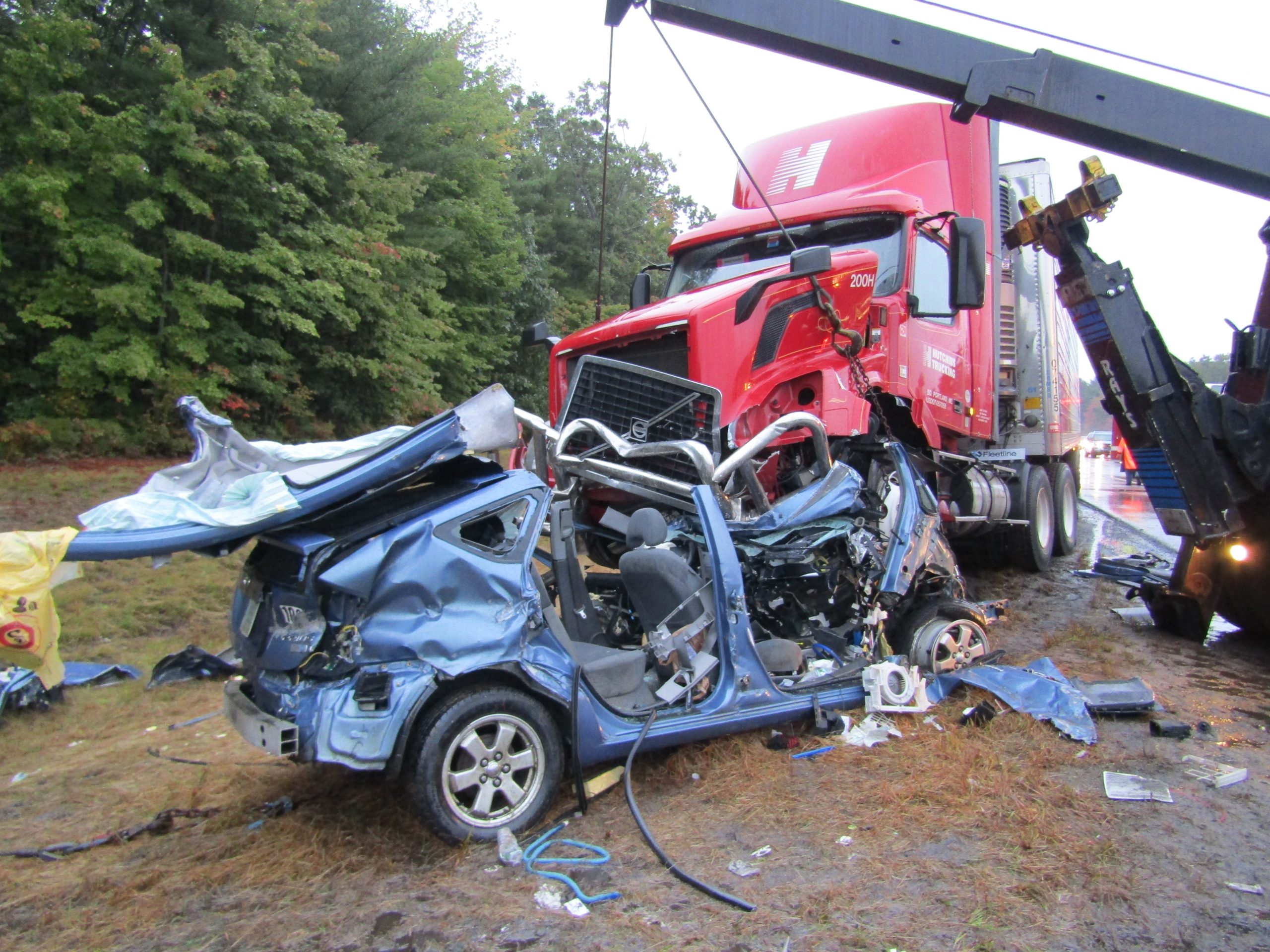
But recently I met members of a Georgia family who are incredibly blessed to be alive. A tractor trailer crossed the median of an interstate highway and struck them head-on. Another truck struck them from behind, knocking them back into the first truck. Miraculously, none of them were catastrophically injured. Of course they had some injuries, but it is amazing that anyone came out alive.


Continue reading "A remarkably blessed family in truck wreck" »

Bookmark and Share

January 5, 2010

Charlotte crash highlights rule that tractor trailer drivers when stopped must put out reflective triangles or flares

As a trucking accident attorney in Atlanta, Georgia, I try to keep up with what 's going on in neighboring states. Yesterday morning in Charlotte, NC, a motorist was killed when he hit the rear of a parked tractor trailer in an emergency lane.

The Federal Motor Carrier Safety Regulations, at 49 C.F.R. § 392.22, requires that when a tractor trailer stops on a highway or shoulder, the driver must activate hazard warning signal flashers, and within ten minutes must place either bidirectional reflective triangles or flares.

I don't know the details of this tragedy in Charlotte, but I do know some of the questions that should be asked.

Continue reading "Charlotte crash highlights rule that tractor trailer drivers when stopped must put out reflective triangles or flares" »

Bookmark and Share

January 2, 2010

Beware of law firms not licensed in Georgia but advertising for Georgia cases

Recently a Texas law firm has begun aggressively advertising for Georgia trucking accident cases through Google and Youtube, directly soliciting for Georgia cases even though that firm has no Georgia attorney and no Georgia office.

To a consumer looking at the Texas firm's web content, without reading the fine print, it looks like the firm is in Atlanta or Savannah. However, the Texas firm has no "boots on the ground" in Georgia. This presents a substantial danger for consumers responding to that firm's advertising.

While Federal Motor Carrier Safety Regulations are the same throughout the nation, the laws of torts, civil procedure and evidence vary from state to state. We don't market to target cases in other states. When we get cases in neighboring states, the first thing we do is associate local counsel with intimate familiarity with the specific court where the case would be tried.

Although an out of state firm has some latitude in handling matters up to the point of filing suit, ignorance of local rules and practice creates great danger for anyone hiring a Texas law firm for a Georgia case. Lack of familiarity with Georgia laws, court rules, legal culture and practices can be deadly.

If you have a serious case in Georgia, you need a seasoned Georgia trial attorney who knows the lay of the land in Georgia, and who is known in Georgia.


Continue reading "Beware of law firms not licensed in Georgia but advertising for Georgia cases" »

Bookmark and Share

December 16, 2009

J. B. Hunt tractor trailer runs stop sign, hits family van in Spalding County, Georgia

A mom and her three preschool children were injured on December 4th in Spalding County, Georgia, when a J. B. Hunt tractor trailer ran a stop sign and hit the passenger side of the family van.

According to the Georgia State Patrol spokesman, Cindy Lynn Fain, 38, of Hampton, was driving her Dodge minivan when the tractor trailer ran a stop sign and hit her vehicle. Her three seriously injured children were airlifted to Children's Healthcare of Atlanta at Egleston, while the mom was taken to Spalding Regional Medical Center.

The Griffin Daily News reported that a 5-year-old girl in the van was in critical condition in ICU with a serious head injury and complex fractures of her left lower leg and foot. The 4-year-old child had a broken hip, and the 2-year-old had a less serious head injury.

According to a report by Mashaun Simon in the Atlanta Journal Constitution, the tractor trailer was driven by Solomon Debela, 37, of Tucker, Georgia. Debela was charged with failure to stop at a stop sign, failure to obey a traffic control device and charged for driving a truck on a no-thru truck road.

A report by Sheila Marshall in the Griffin Daily News states that Debela was a driver for J. B. Hunt, one of the largest trucking companies in America, and that he did not even try to stop at the stop sign.

Commercial trucking accidents are seldom as simple as one guy disregarding a traffic signal. When we dig in, we usually find that the corporate safety management policies and practices, and a tendency to turn a blind eye to unsafe practices, lie behind nearly every trucking tragedy. Lawyers who think these are just bigger car wrecks are dangerously naive and do a disservice to their clients.

Continue reading "J. B. Hunt tractor trailer runs stop sign, hits family van in Spalding County, Georgia" »

Bookmark and Share

June 30, 2009

18 wheeler kills family in Mississippi

Last Tuesday in Magee, Mississippi, a tractor trailer crashed into the rear of a family van stopped at redlight. All four members of the family in the van were killed.

The 18 wheeler was operated by JNJ Express of Memphis. According to the Federal Motor Carrier Safety Administration, JNJ Express is a general freight hauler with 181 power units, 184 drivers and 11 injury crashes within the past 24 months. Only a first layer of insurance coverage, in the amount of $1,000,000, is listed on the FMCSA web site.

Continue reading "18 wheeler kills family in Mississippi" »

Bookmark and Share

June 30, 2009

9 killed in Oklahoma tractor trailer crash

On Friday, 6/26/09, on I-44 near Miami, Oklahoma, a tractor trailer slammed into a line of stopped traffic, killing nine people.

The tractor trailer driver apparently made no attempt to slow or stop. Whether the driver was fatigued or distracted was not immediately reported.

Witnesses described the pileup in 100 degree heat as looking like a war zone, filled with twisted metal and dead bodies.

Investigation and discovery in such an incident should include careful examination of the driver's logs, trip receipts, bills of lading, Prepass records, driver qualifications, and a long list of other operational records, as well as the driver qualifications, vehicle maintenance, etc.

Reportedly the tractor trailer was 76 years old. We have handled several cases in which elderly truck drivers made tragic errors related to their medical conditions, including COPD (chronic obstructive pulmonary disorder) or obstructive sleep apnea. While there is no hard age limit on truck drivers, the potential relation between age and physical condition is well known. One must question whether there were any violations of Driver Physical Qualification rules uner 49 CFR Part 391.41, including:

- Has no loss of a foot, a leg, a hand, or an arm.
- Has no established medical history or clinical diagnosis of diabetes requiring insulin for control. (injection only)
- Has no clinical diagnosis of any disqualifying heart disease.
- Has no clinical diagnosis of epilepsy.
- Has 20/40 vision or better with corrective lenses.
- Has the ability to recognize the colors (red, green and amber) of traffic signals.
- Has hearing to perceive a forced whisper.
- Has no history of drug use.
- Has no clinical diagnosis of alcoholism.

Compounding the tragedy is the fact that the amount of liability insurance required of interstate motor carriers has not been adjusted for inflation in decades. The minimum requirement of $750,000 -- or the more common $1 million policy -- is grossly inadequate for a tragedy of this magnitude. Attorneys working on such a case must explore all other potential sources of liability coverage, including a separate MCS-90 endorsement on the trailer, and potential exposure of shippers, brokers, etc., though those are tough theories of liability.

Continue reading "9 killed in Oklahoma tractor trailer crash" »

Bookmark and Share

March 18, 2009

How insurance adjusters lull you into complacency in order to take advantage of you

When you or a loved one have been badly hurt in a catastrophic trucking accident, you may expect someone from the trucking company or its insurer to try to lull you into complacency. The objective is to avoid paying the value of the case, which they recognize is substantial. The tactics may remind you of the old joke, “I’m from the government and I’m here to help you.” They are from the insurance company and are “here to help you.”

The standard tactics, which my friend Morgan Adams in Chattanooga discussed in a recent blog post, include some variation of the following:

1. Pretending to be your friend. At trucking defense seminars, claims adjusters talk about how they try to become friends with a family by apologizing and offering to buy them a car and a house in exchange for giving up their claims. The adjusters take every opportunity to demonize any lawyers that the family might hire to represent them. At all costs they want to prevent the family from talking to an experienced trucking lawyer who would know how to investigate the case, demand that the company preserve paper and electronic records, and discovery trucking company’s violations of laws that contributed to causing the crash. In one recent case we handled, the adjuster started out talking to the family about paying their deductibles and copays on medical expense, and replacing their car, while at the same time trying to dispose of the physical evidence. But when the family hired me, and I deployed a rapid response to preserve evidence and make appropriate demands, the company soon paid its million dollar policy limit. Insurance adjusters know that revealing the truth could increase the value of the case significantly, and will do whatever they can to prevent that.

2. The misuse of annuities. Structured settlement annuities are a useful tool in settling cases because all the lifetime payments are tax-free and the burden of managing investments is lifted. However, in considering structured settlements, it is essential to focus first on what the defendant or its insurer is paying. Insurance companies will often show an unrepresented plaintiff that they will pay your family a million dollars over the next thirty years, while failing to mention that the annuity only costs $100,000 (or whatever) while the case has a present fair value in excess of a million dollars. In addition, they will use one of their own affiliated companies and brokers to issue the annuity, just switching the money from one hand to another. Thus, they play a shell game and get by with paying only a fraction of what the case is worth.

3. Inflation. No one knows exactly what future inflation will be, but we know that historically there is likely to be inflation. The adjusters will not seriously discuss with you how inflation will affect the value of funds paid.

4. Future medical expense. They exclude consideration of future medical expenses that eat into money paid to the family.They often fail to inform you of the impact of reimbursement claims by your health insurer, and do not protect your interests against such claims.

5. Future income loss. They exclude consideration of the full loss of income of the victim. People who have had major injuries often can’t work as much or as long as they would have, even if they initially return to work at the same job and at the same rate of pay.

6. Non-economic loss. They treat the non-economic losses of the family as having little or no value. The loss of quality of life, or the loss of a parent, is a matter of immense value which must be accounted for in a fair settlement of a case.

Remember the insurance adjuster’s job is to try to minimize payments on claims. No matter how friendly they may act, they are not there to help you.

Continue reading "How insurance adjusters lull you into complacency in order to take advantage of you" »

Bookmark and Share

February 13, 2009

Tractor trailer rear-ends car near Furman campus, woman airlifted to hospital

Today a tractor trailer rear-ended a car near the campus of my undergraduate alma mater, Furman University in Greenville, SC. The lady in the car was airlifted by helicopter to Greenville Memorial Hospital.

How many hundred times have I passed that spot?

I'm scheduled to help judge the collegiate mock trial competition at Furman in late March.

Continue reading "Tractor trailer rear-ends car near Furman campus, woman airlifted to hospital" »

Bookmark and Share

January 1, 2009

Two cement mixer truck rollovers highlight special handling characteristics

Two cement mixer trucks rolled over yesterday morning in Mississippi. This highlights something I have learned as a Georgia trucking accident attorney.

In loaded cement mixer trucks the center of gravity is high and constantly shifting. Road tests described in standard truck driver training materials in the ready-mix concrete industry graphically describe the handling characteristics. It is well known in the industry, and covered in training videos and Power Point presentations, that a loaded cement mixer truck will tip up on two wheels when making a ninety degree turn on level pavement at 12 miles per hour, and will roll over at 16 miles per hour.

Recently I handled a case in which cement mixer truck in Georgia rolled over when making a turn in a level intersection, landing on a family vehicle. The cement truck driver had just obtained his CDL a couple of month earlier, and his training on cement mixer truck driving consisted of showing him how to work the mixer controls. At his deposition, I showed the driver the standard industry training video. He swore that he had never been trained on any of that, and if he had been trained the accident and injury would not have occurred.

The cement company admitted responsibility for its driver and filed a motion to exclude to independent negligence claims against the corporation for its negligent hiring, training, entrustment and supervision. However, when we responded to their motion with a brief showing that under the Georgia tort reform legislation that requires apportionment of damages between the employer and driver, they soon agreed to a fair settlement in mediation.

Continue reading "Two cement mixer truck rollovers highlight special handling characteristics" »

Bookmark and Share

December 31, 2008

Tractor trailer wreck on I-85 Georgia due to bad tire

This morning on I-85 near Newnan, Georgia, a tractor trailer wrecked due to a blown tire. A 72-year-old trucker driving a 1996 International 4000 tractor-trailer crashed when a right tire reportedly blew on the vehicle, causing him to lose control and strike a guardrail. Fortunately, no injuries were reported. It was a local truck delivering concrete forms.

Most of the Federal Motor Carrier Safety Regulations have been adopted for intrastate trucking within Georgia. The FMCSR, at 49 CFR 396.13, requires the driver to make a pre-trip inspection and sign a report noting any defect in equipment. The FMCSR at 49 CFR 392.7, specifies that the pre-trip inspection driver must confirm that the following are in good working order: service brakes, including trailer brake connections; parking (hand) brake; steering mechanism; lighting devices and reflectors; tires; horn; windshield wiper or wipers; rear-vision mirror or mirrors; coupling devices.

Continue reading "Tractor trailer wreck on I-85 Georgia due to bad tire" »

Bookmark and Share

December 26, 2008

Gasoline tanker crashes and explodes on Lookout Mountain

Driving a gasoline tanker truck is one of the most dangerous and nerve-racking of occupations. I have heard from tanker truck drivers that they live in constant amprehension of disaster. After a relatively minor collision, their stress may suffer a form of post-traumatic stress disorder from contemplation of the close call.

This week a gasoline tanker truck operated by Florida Rock and Tanklines crashed and burned on Georgia Highway 157 on Lookout Mountain, as reported by WTVC television in Chattanooga. The driver was killed in the resulting explosion and fire.

Highway 157 is a beautiful route through a bucolic mountaintop landscape. Until I was 12 I lived at Mentone, Alabama, on top of Lookout Mountain, and went to school at Menlo, Georgia, in Shinbone Valley, so the site of this fiery crash is just a few miles north of the route I rode to school every day.

Bookmark and Share

December 13, 2008

Forklift on tractor trailer takes chunk out of Texas overpass

I've been working on trucking accidents in the Atlanta, Georgia, area for a long time. Today's news includes a report of an accident in Arlington, Texas, that reminds me of my first tractor trailer wreck case.

According to a report by Lita Beck of the NBC affiliate station in Dallas - Fort Worth, an 18-wheeler hauling a forklift hit the State Highway 360 overpass Wednesday night, taking a chunk of the overpass near Six Flags Over Texas.

Back in the mid-1980's when I was an associate at an insurance defense law firm in Atlanta, I was assigned to defend a trucking company that was hauling a construction crane up I-75 in Cobb County when the crane boom came loose and started extending upward. The boom crashed into the Windy Hill Road bridge, wreaking havoc and allegedly moving the bridge over an inch or two.

No one was injured, but someone at the Georgia Department of Transportation saw an opportunity to get the trucking company's insurer to help pay for a new bridge that was planned. When GDOT sued for the cost of a new bridge, I served a notice to take the deposition of the then-commissioner of GDOT to examine him about the bridge plans, budget projections, etc. Before the date of the deposition, GDOT settled for the reasonable cost of repair -- not replacement -- of the old bridge.

Continue reading "Forklift on tractor trailer takes chunk out of Texas overpass" »

Bookmark and Share

November 25, 2008

Truck wreck kills three in hazardous weather

In my trucking litigation law practice, I all too often see fatal truck accidents that happen in bad weather Despite a federal safety regulation requiring "extreme caution" in hazardous weather, and instructions in the Commercial Drivers License Manual to slow down by at least one-third, truckers under economic pressure from employers, shippers, and sometimes their own creditors, too often speed ahead through rain and snow.

The most recent such crash in the news was yesterday on I-81in Virginia's Shenandoah Valley, a road I know well.

It happened about 11:30 a.m. near New Market, Virginia. The road was slickened by snow. A big rig operated by Jose Alberto Sarmiento of Texas, hit several vehicles before rear-ending of a Ford Escort, killing three members of a Virginia family.

According to a report by Pete DeLea in the Daily News Record of Harrisonburg, VA, Sarmiento has been charged with reckless driving and three counts of felony involuntary manslaughter.

The Federal Motor Carrier Safety Regulations, 49 C.F.R. § 392.14 requires:

Extreme caution in the operation of a commercial motor vehicle shall be exercised when hazardous conditions, such as those caused by snow, ice, sleet, fog, mist, rain, dust, or smoke, adversely affect visibility or traction. Speed shall be reduced when such conditions exist. If conditions become sufficiently dangerous, the operation of the commercial motor vehicle shall be discontinued and shall not be resumed until the commercial motor vehicle can be safely operated. Whenever compliance with the foregoing provisions of this rule increases hazard to passengers, the commercial motor vehicle may be operated to the nearest point at which the safety of passengers is assured.

Every reported case that addresses the issue agrees that it is reversible error for a trial court not to instruct a jury on this "extreme caution" standard.

In Crooks v. Sammons Trucking, Inc., 2001 WL 1654986 (Cal.App. 3 Dist.,2001), a tractor trailer sped through blowing snow until striking another tractor trailer. The trial court denied a request to charge on the “extreme caution” standard under 49 C.F.R.§ 392.14, instructing the jury instead on the state standard of ordinary negligence. The appellate court reversed, holding that the trial court should have charged on the higher federal regulatory standard rather than the lower standard provided by state law. The same decision was reached in Weaver v. Chavez, 133 Cal.App.4th 1350, 35 Cal.Rptr.3d 514 (Cal.App. 2 Dist.,2005). Clearly, if the federal “extreme caution” standard preempts a state rule of “ordinary care,” the reasons are even stronger for it to preempt a state standard of “willful or wanton misconduct.”

The Minnesota Supreme Court in George v. Estate of Baker, 724 N.W.2d 1 (Minn.,2006), held that it was reversible error to give a “curative” instruction contradicting an attorney’s argument that a “reasonable care” standard did not apply, even though the full instructions included reference to standards of “utmost care” and “extreme caution.”

In Kentucky, Jurek v. Hubbs, 2004 WL 1487116 (Ky.App.,2004), involved denial of the plaintiff’s motion for directed verdict based on 49 C.F.R.§ 392.14 rather than jury instructions. However, the court recognized that the Federal Motor Carrier Safety "regulations govern the operation of commercial motor vehicles in the United States. To the extent that they establish a standard of care higher than the law, ordinances, or regulations of a particular state jurisdiction, a commercial driver must comply with the FMSCR."

The Virginia Supreme Court held, in Kimberlin v. PM Transport, Inc., 264 Va. 261, 563 S.E.2d 665 (Va.,2002), that it was reversible error to direct a verdict for the defendant where there was a question of fact whether truck driver violated the duty created by 49 C.F.R.§ 392.14 to exercise extreme caution under hazardous conditions and whether violation of such duty was a proximate cause of the accident. The court noted that while violation of the regulation does “not constitute negligence per se [It] simply creates an expanded duty of care for the operation of commercial motor vehicles under the conditions stated therein.”563 S.E.2d at 668-69.

Continue reading "Truck wreck kills three in hazardous weather" »

Bookmark and Share

September 24, 2008

Florida truck driver on cell phone hits school bus, kills child

A Florida truck driver admitted that he was on his cell phone yesterday when he slammed into a school bus, killing a 13-year-old student. According to reports, the school bus, which had stopped to let children off , had its warning lights on and stop signs out. The truck failed to stop for it and rammed the school bus forward 294 feet.

See our recent posts on cell phone distractions and the absence of seat belts on busses.

Continue reading "Florida truck driver on cell phone hits school bus, kills child" »

Bookmark and Share